
Does UNK’s Faculty Union Represent Nebraska — or Washington?
by Sue Greenwald, M.D.
In two recent essays, we raised concerns about the direction of the University of Nebraska at Kearney.
First, we questioned why UNK’s Family Studies program eliminated infant and child development courses, removed “marriage” from course titles, and shifted more heavily toward controversial sex education frameworks. Second, we asked whether the university is fully honoring its contractual obligations to faculty.
Those are important issues on their own. But together they raise a broader and more uncomfortable question:
Who actually speaks for the faculty at UNK?
The Union Structure Most People Don’t See
UNK faculty are represented for collective bargaining by the University of Nebraska at Kearney Education Association (UNKEA). UNKEA is affiliated with the Nebraska State Education Association (NSEA), which is affiliated with the National Education Association (NEA).
That’s not unusual. Many faculty unions have state and national affiliations.
But here’s what matters: the NEA is not just a labor organization focused on salaries and benefits. It is a major political actor. It adopts formal policy resolutions on family structure, sex education, gender identity, and a range of social issues. It operates political action committees. It spends significant sums on political lobbying and campaign activity.
These 2022 numbers from AmericansForFairTreatment.org show that the union is spending more on political advocacy than it admits. Their advocacy is almost completely for far-left causes.
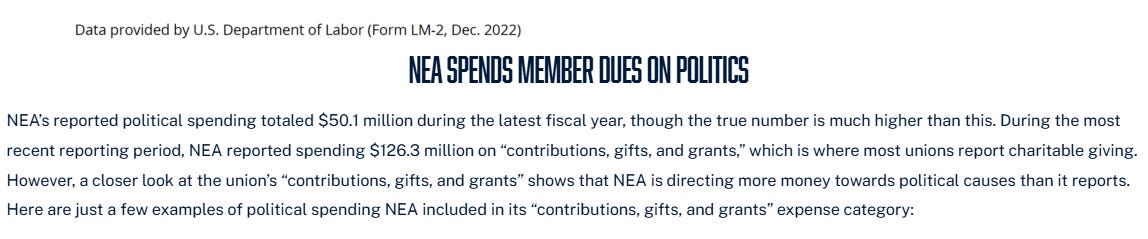
“NEA’s reported political spending totaled $50.1 million during the latest fiscal year, though the true number is much higher than this. During the most recent reporting period, NEA reported spending $126.3 million on “contributions, gifts, and grants,” which is where most unions report charitable giving. However, a closer look at the union’s “contributions, gifts, and grants” shows that NEA is directing more money towards political causes than it reports. Here are just a few examples of political spending NEA included in its “contributions, gifts, and grants” expense category:”
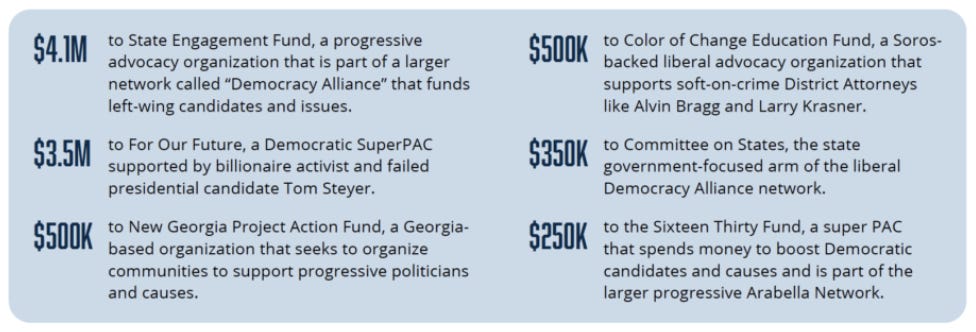
Therefore, whether they agree or not, all faculty at the University of Nebraska at Kearney are represented by a subsidiary of the National Education Association. The same NEA that wants your children to choose their own gender, learn that America is a racist oppressive nation, and call mothers “birthing persons”. As reported by Fox News:
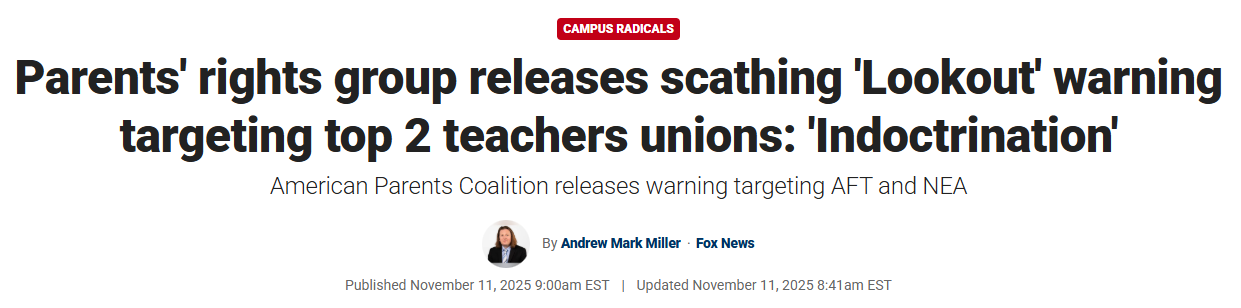
The warning, sent by the American Parents Coalition, targets the American Federation of Teachers (AFT) and National Education Association (NEA) and, in addition to concerns about student outcomes not being the priority, highlights a report that it says shows the unions “have invested hundreds of millions of dollars in woke organizations.”
The APC warning hits the NEA and AFT for pushing a variety of far-left causes, including boycotts in support of DEI, legal and activist campaigns against the Trump administration, denouncing a Supreme Court ruling that “enabled parents to opt their children out of age inappropriate and one-sided LGBTQ+ content,” and climate activism.
"Parents should be aware of the outsized influence these unions have on their child’s school, because these organizations may be pushing policies that undermine parental trust and do nothing to further a child’s education. Every year the teachers’ unions funnel millions of dollars into campaigns and activist causes that almost exclusively favor Democrats, while students continue to fall further and further behind on foundational subjects.”
There are faculty at UNK that are conservative, and UNK serves a state that is largely conservative. That tension between union values and conservative values is worth acknowledging.
Voluntary Membership — Mandatory Representation
Here’s another structural detail most people don’t realize: UNK faculty are not required to join UNKEA. Membership is voluntary, and many faculty choose not to become dues-paying members.
Yet UNKEA is the exclusive bargaining representative for all faculty. It negotiates the Collective Bargaining Agreement (CBA) that governs every faculty member’s employment, member and non-member alike.
So we have:
· Voluntary membership
· Universal bargaining authority
An organization that does not include all faculty still negotiates binding employment terms for all faculty.
Again, this is legal and common. But it raises a fair question about representation and alignment.
Advocacy Isn’t Evenly Distributed
There is another important wrinkle.
While UNKEA negotiates the CBA for everyone, individualized representation in grievances or contractual disputes is strongest for dues-paying members. Non-members are covered by the agreement, but they do not receive the same level of direct union-supported advocacy in individual cases.
This becomes especially important during periods of workforce reduction, like what is happening right now.
So the union structure at UNK looks like this:
· Universal bargaining authority
· Partial membership
· Strongest advocacy reserved for dues paying members
Again, this is not an accusation. It is how many union systems function.
But when that system is formally affiliated with national organizations that take strong positions on contested social issues, dissenting faculty may reasonably wonder whether their perspectives are protected.
Culture and Alignment
In our earlier essay, we questioned whether shifts in UNK’s Family Studies program reflected broader ideological trends in higher education. No one is claiming that the NEA writes UNK’s syllabi. Universities retain academic autonomy.
But institutional culture does not operate in a vacuum.
Affiliations matter. Professional networks matter. Policy language travels. Conferences shape norms. Over time, alignment with national advocacy organizations can influence institutional tone — even subtly.
In such an environment, faculty who advance progressive frameworks on family and sexuality may reasonably perceive institutional affirmation, while faculty holding traditional or conservative views may feel less confident that their perspectives are equally protected.
In a state like Nebraska, where taxpayers and families hold a wide range of political and religious beliefs, that alignment deserves scrutiny.
This Is a Governance Question
This essay is not an attack on unions. It is not an allegation of conspiracy. It is not a claim that anyone is acting in bad faith.
It is a governance question.
If the faculty’s exclusive bargaining representative is connected to national organizations that are deeply engaged in progressive public policy advocacy, and if membership is voluntary but bargaining authority is universal, then it is reasonable to ask:
Who speaks for the faculty — and what else do they speak for?
Public universities depend on trust. Trust depends on transparency. And transparency requires clarity about how representation works — not just in contract negotiations, but in institutional alignment and public accountability.
Nebraska deserves that clarity.
The author is a co-founder of the Nebraska Education Coalition, a parent advocacy group. We appreciate our subscribers.